Showing posts with label boeing. Show all posts

Monday, November 14, 2011

Boeing Signs Record-Breaking Deal

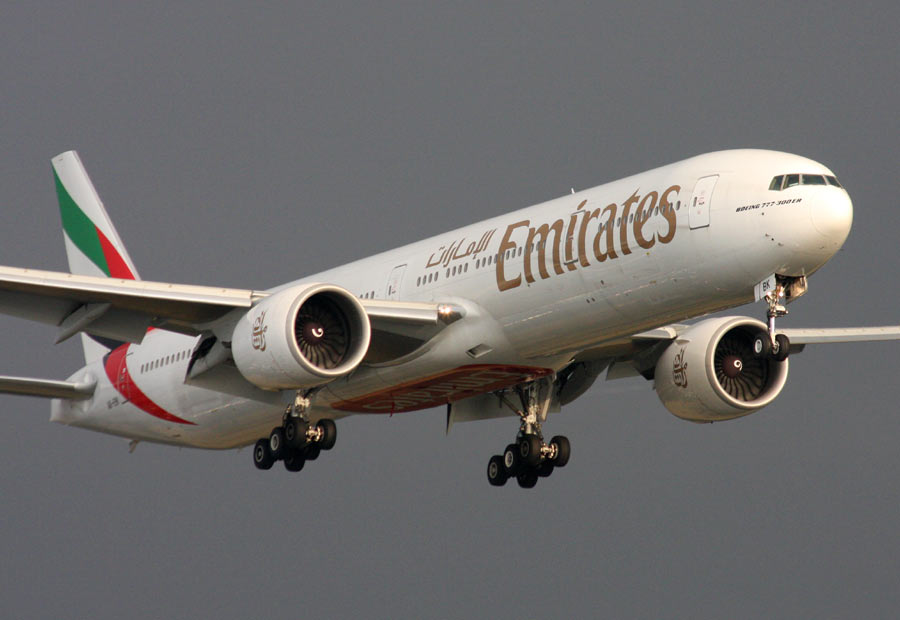
Emirates Airlines 777
CNN: Boeing and Emirates Airlines have signed an $18 billion deal -- the largest deal in the aircraft manufacturer's history -- to supply the airline with 50 aircraft, with options to expand the deal even further.

U.S.-based Boeing has agreed to build 50 of its 777-300ER airliners for the Dubai-based Emirates Airlines, the companies said. The agreement also contains options to supply an additional 20 aircraft, which could add $8 billion to the deal.
At $18 billion, this is already Boeing's largest deal as measured in dollars, the aircraft manufacturer said Sunday. The company also said this is a record year for the 777, with orders for this year totaling 182 so far. That breaks the prior record of 154 orders in 2005.
Emirates' fleet of 94 777s is the largest in the world, according to Boeing. The 777-300ER is designed for long-haul flights, with the "ER" standing for "extended range."

The magnitude of the deal provides a hopeful sign about the economy. Airlines in particular suffered when fuel prices spiked in 2008, and have coped by eliminating their least fuel-efficient flights and by adding fees to services that were once included in the fare, like food, check bags and pet travel.
Boeing also unveiled the 787 Dreamliner last month. After long delays in production, the Dreamliner made its first commercial flight on Oct. 27 from Tokyo to Hong Kong.

The Dreamliner is the first commercial jet to be built from light-weight composite material made from carbon fibers. United Continental Airlines is the first U.S. carrier to take delivery of the plane, which it plans to start flying next year.
United also recently launched its first biofueled flight, with a 737-800 produced by Boeing.
Emirates, which refers to itself as "the world's fastest growing airline," released its results for the first half of its fiscal year on Nov. 3, saying that it had added 10 aircraft and 3,400 staffers during that time.

Emirates now has 161 aircraft, ramping up its fleet from 60 in the last seven years.

Friday, November 11, 2011

Flying on Boeing's 787 Dreamliner


FlightGlobal: So, what is it like to fly the 787?

To The Ear
While I did have at least a general idea of what to listen for, the 787's "more-electric" systems architecture have noticeably changed the sound of flying. In the cabin you immediately get a sense there are fewer moving parts surrounding you. The sound is less low mechanical rumble and more high-pitch buzz, which ultimately defines the low noise level in the cabin. If there is an appropriate automotive equivalent, it was reminiscent of the sound a hybrid-electric vehicle makes compared to a traditional internal combustion engine. It's not until the twin Rolls-Royce Trent 1000 engines are spooled up that you realize just how different 787 is from the passenger's perspective.

After two flights on JA801A to Hong Kong from Narita and back, I became used to the sights, sounds and smells (or lack thereof) around me. Following the flight, passengers asked each other if they could feel the different features of the cabin; the higher pressure (lower altitude), higher humidity and lower noise. It wasn't until I boarded my flight back to New York on an All Nippon Airways 777-300ER, that the contrast became stark.

At first, I chalked the different feeling in the air to the "new airplane smell", but when contrasting JA801A to the 16-month old JA787A, the air was noticeably different and significantly dryer. By comparison, the feeling aboard 787 felt as though the cabin door was never really closed.

787, like that of the much larger A380, known for its quiet cabin, has a near-silent taxi. There is very little audible difference between sitting at idle engine speed and rolling along the taxiway.

I've posted two audio files comparing the 787 and 777-300ER takeoff rolls. Each was recorded with an iPhone 4 inside the aircraft's cabin, positioned just aft of the engines, under the 44 Section to control the variability in recordings as much as possible.

Admittedly, this is an unfair comparison as our 787 was lightly loaded with 240 passengers, no extra cargo, and sported two 64,000lb engines. This is compared to a heavily loaded 777-300ER, fueled for a trans-pacific crossing with just one of its General Electric GE90-115B engines able to produce nearly as much thrust as the two de-rated Trent 1000s combined, but it should give you a sense of the different sounds of each aircraft.

On climb-out the gear retraction and flap motors were extremely quiet as well. Once at cruising altitude, one aerospace journalist remarked that the ride on 787 through still air felt akin riding on an airship, citing the Hindenburg by name. Minus the obvious historical divergences, the 787's cruise appeared to be smoother than the 777, though this may be more a factor of the reduced cabin noise than the aircraft's aerodynamics and flight controls.

While the 787's cabin is absolutely quieter than both the aircraft it replaces (the 767) and its larger sibling (the 777), one area of the cabin is notable for how loud, not how quiet, it is. The 787's signature LED lit door two archway has a significantly different noise profile than the cabins that are both forward and aft of the entryway. The explanation for this is fairly straightforward: With no bins, no seats, fewer sidewalls and two doors, there simply isn't as much to absorb the wind and engine noise.

To The Eye
Being a passenger on 787, aside from the lighting, the largest difference are the windows. When you're in Boeing's static mock-up of the cabin, there's a feeling of detachment to the outside environment, but it's not until you sit down and there's a world outside your window, are you fully able to appreciate the wider view.

Worth noting, my aisle seat at 12C afforded me an easy opportunity to shoot video out the window. First, I had a very understanding seatmate, and second, the windows were big enough that I was able to rest my DSLR on the headrest of the window seat with no problem.

While it remains hyperbole to say that every seat is a window seat aboard 787, the 18in high windows change the the overall feeling of the cabin in a very real way.

The display of rainbow lighting on our taxi out from Narita was definitely unique, but it wasn't until flight attendants took control of the windows during the flight, darkening them to full opacity, when it remained a sunny day on the other side of the fuselage that we could see the full effect. The LED lighting does get washed out a bit by the added light from the larger windows (not a bad thing), but its full capability will be seen during long overnight flying in a dark cabin.

Admittedly, the dimming window shade takes a really long time to return to full transparency. Say, if you're trying to take a photograph, for example, it leaves a darkish cloud in the middle of the pane for a while after the edges have returned to clarity. Though I'd imagine that the slow rate of change will dissuade some on board from treating the dimmer as a cabin strobe light. (Dimming phases 1, 2, 3, 4, 5)

User-Friendly Lavatories
Boeing has added a very useful feature to the outside of the 787s lavatories: A traffic light. This is a feature that has been on the A380 since its inception, in the form of forward cabin indications that show when the lav is occupied. The 787 puts a green or red light (depending on occupancy) above each door that can be seen from most seats, and for those out of sight, a small drop-down monitor at the forward part of each cabin also illustrates if the lav is available. Upon entry, the default lighting is a deep purple glow that gives way to softer and more even lighting. As you've seen before, the lavatory is entirely hands-free.

One issue that may crop up in the near future is the lavatory door itself, which makes a jarring slamming sound when being closed. And no, I did not test drive the washlet (bidet).


A Tip of the Hat
There's a subtle on-board homage to the origins of the 787, found in a most unlikely location. The Panasonic IFE moving map display features an aircraft icon - hardly unusual - that denotes the current progress of the flight. That icon, you'd expect, would be a 787. It's not. In fact, it's the original 7E7. The miniature airplane icon clearly shows the bottle nose and swept wings, shark fin and bottle nose that stood as Boeing's artist conception of its new mid-size jetliner. It is a fitting, if subtle, nod to the origins of the aircraft's design.

Monday, November 7, 2011

ANA Reports First Dreamliner Glitch

787 Landing Gear
Seattle Post Intelligencer:  Boeing Co. and All Nippon Airways are investigating a potential glitch with Boeing's new 787 Dreamliner.
The Tokyo-based airline, which was the first to take delivery of the revolutionary new jetliner, says the landing gear on a 787 did not deploy properly.

According to news reports, the Dreamliner had to abort an approach at Okayama airport and circle around again after the landing gear failed to come down automatically.

The pilot of the Boeing 787 had to manually deploy the main landing gear in order to bring the plane down safely.

The incident took place Sunday.

On Monday morning, All Nippon Airways reported that a monitor issued a warning that the problem was with a faulty hydraulic valve.

This is the first glitch for the Dreamliner since its first commercial foight from Tokyo to Hong Kong on Oct. 26.

An airline spokesperson says the jet was carrying 249 passengers at the time of the incident and ultimately landed with no problems.

The incident comes days after a Boeing 767 landed on its belly in Warsaw after the landing gear failed to deploy.

Wednesday, October 26, 2011

First 787 Commercial Flight Lands in Hong Kong

The Boeing Company’s Dreamliner, the world's first carbon-composite airliner, flew from Tokyo to Hong Kong today carrying its first paying passengers.

The plane's takeoff into clear blue skies after a salute and shower by an airport fire truck marked what its maker hopes will set a new benchmark in air travel. The Dreamliner won't fly any faster than the first 707 jetliner the U.S. company built a half century ago, but it's designed to make the hours aloft more pleasant for passengers and cheaper to fly for its owners.

The Dreamliner that flew today is owned by All Nippon Airways Co. A jubilant Shinichiro Ito, the airline's president and CEO, described his brand new plane as a "game changer." He acknowledged, however, that production hiccups that delayed delivery for three years had put his carrier "through hard times."

Passengers on the flight were treated to shifting hues of color, including a rainbow display as the aircraft lifted off from the tarmac in Tokyo, its engines a gentle whistle. Other amenities include windows that are 30 percent bigger and which can be dimmed electronically, seat-to-seat e-mail, bidet-equipped lavatories with their own windows, and bigger touch screen entertainment panels.

Video:

Sunday, October 23, 2011

Revolutionary Dreamliner to Begin Service Wednesday


USA Today: The Dreamliner, Boeing's 787 jet that's touted as a revolutionary change in how passenger planes are made, is taking to the skies — at last.

On Wednesday, the world's first jet to be made mostly of carbon fiber, instead of traditional aluminum and steel, will carry passengers for the first time when Japanese carrier All Nippon Airways (ANA) flies from Tokyo to Hong Kong with 264 travelers on board.

The flight is a coming-out party for a jet that reflects the biggest change in aircraft construction since metal replaced wooden biplanes. The Dreamliner's relatively light weight and aerodynamic features promise to cut fuel costs up to 20% and enable airlines to reap profits from new non-stop routes. The jet also aims to attract passengers with cabin comforts that include overhead bins and windows larger than those on current passenger jets.

Excitement about the Dreamliner has been so great that it's become the fastest selling twin-aisle commercial jet in Boeing's history — before a single one rolled off the assembly line.

"This is a huge leap," says Jon Ostrower, editor of Flightblogger.com, who has chronicled the Dreamliner program. "If it's not a revolution, it's a very significant evolution of the way we're used to flying and the way we're used to seeing airplanes put together."

But the Dreamliner is also a source of pressure for Boeing, which delivered the first one three years later than planned. While the Dreamliner's debut was being delayed by parts shortages, work stoppages and other problems, Boeing's chief rival, European aircraft-maker Airbus, was working on a mostly carbon fiber jet of its own that is set to begin test flights next year. There also are questions about how long it will take for the new jet to turn a profit for Chicago-based Boeing. While Boeing will not say how much it spent creating the jet, its price ranges from $193.5 million to $227.8 million.

Boeing, which has sold 821 Dreamliners, brushes off concerns that the delays in getting the jet in the sky are causing financial or production headaches to meet aggressive delivery schedules. Instead, Boeing says, the nation's biggest manufacturing exporter has made a wise investment in a jet that will pay dividends for years to come.

"We really have delivered a game-changer to the marketplace," says Scott Fancher, Boeing vice president and general manager of the 787 program. "We've made an investment in a set of technology that will be with us for 20 to 30 years and serve as a basis for the development of our new airplanes as we go forward."

Impressive innovations
There's no doubt the Dreamliner represents a big change in the way planes are made. Its body is 50% composites by weight, a material that makes the midsize, twin-aisle Dreamliner light and strong. Other jets have incorporated composites, but not to the extent Boeing has put them into the 787.

The payoff for airlines is the ability to fly long-distance trips without burning as much increasingly costly jet fuel as other similar-size planes. The Dreamliner's unique makeup also won't corrode as easily as other jets, making it 30% less costly to maintain, Boeing says.

"This is the first major change in overall fuselage structure since going from wooden to metal airplanes," says industry consultant George Hamlin of Hamlin Transportation Consulting in Fairfax, Va.

The Dreamliner can carry 210 to 290 passengers. It could pave the way for airlines to have new, direct flights between far-away cities on routes that otherwise wouldn't have profitably supported non-stop trips on a bigger jet burning more fuel with so few passengers.

"If the airplane performs as advertised, we will see smaller cities getting more international service — the Bostons and Portlands and Clevelands of the world," Ostrower says.

Passengers wanting to fly overseas from those cities now, he says, often "have to fly to a Chicago or (Washington) D.C. to pick up a direct flight on a much larger airplane."

ANA is the first airline to get the Dreamliner, but United Continental won't be far behind. United, which is merging with Continental to become the world's biggest airline, will be the first U.S. carrier to get the 787. It plans to fly it between Houston and Auckland, New Zealand, by the latter half of next year.

That Houston-to-Auckland route is a prime example of how the Dreamliner opens up "new markets that might have been a little bit thinner on the demand side," says Jim Compton, United Continental's executive vice president and chief revenue officer.

If the 787 is making the trip, airlines also could make more money on routes they're already flying, Compton says.

"Fuel is the biggest cost item we have today, so to get 20% savings on that just improves the profitability," he says. "And obviously it's going to draw customers."

Making flying more comfy
At a time many travelers see flying as an ordeal to endure, Boeing says the Dreamliner was designed to make air travel more pleasant from the moment passengers step aboard.

Instead of a narrow portal, fliers will step through a tall, open archway to enter the cabin. When they want to doze or watch a movie, they can push a button to dim their window rather than tug on a shade. The cabin ceiling has lighting that simulates the sky, going from daylight to dusk.

Fliers should feel less knocked around thanks to sensors that help ease turbulence, Boeing says. The engines are designed to be less noisy than those on conventional passenger jets. The Dreamliner's carbon composition allows for higher humidity inside the cabin. That means passengers should be less prone to dry throats and noses or feeling exhausted once they land.

"It really has an effect on how a person feels after a 10- or 12-hour flight," Boeing's Fancher says.

The jet's passenger features have caught the attention of some frequent fliers who are eager for an opportunity to climb aboard a jet that Boeing says will make their hours in the air less arduous.

Clarissa Cervantes, a research associate in Beverly Hills, says she can hardly wait. "I believe this is the future for travel," she says.

Matt Daimler, founder of SeatGuru.com, a website that informs travelers about airline cabin features, says the Dreamliner's 19-inch-tall windows — compared with the 11- to 13-inch windows found on most passenger jets — are a particular treat.

"Being able to see more, and having less of a feeling of claustrophobia in that aluminum tube, is a bonus right off the top," he says.

But some of the Dreamliner's other perks, such as the cabin lighting system, are no longer unique, Daimler says. Competitors such as Airbus have caught up to Boeing while it struggled to get the Dreamliner in the air.

"The challenge with some of the other little things they've talked about is they've found their way to other planes," he says. "So is it as exciting as when they announced it three or four years ago? Maybe not so much anymore."

Unprecedented delays
The Dreamliner was dogged by delays after it went into production in May 2007. Deadlines were pushed back for reasons ranging from a machinists strike in late 2008, to the discovery of a structural flaw in the jetliner in June 2009, to an onboard electrical fire that temporarily grounded all test flights in November 2010.

"I don't recall a three-year delay in a commercial program of any significant size," says industry consultant Hamlin. "Unprecedented probably applies here."

Meanwhile, Airbus was catching up. Its A350 will be made of slightly more carbon fiber — 53% by weight — than the Dreamliner, and the first one is scheduled to be delivered at the end of 2013, says Chris Jones, vice president of sales for Airbus Americas.

Despite its problems, the 787 remains in high demand. Along with ANA and United Continental, Delta, Virgin Atlantic and Vietnam Airlines are among the 56 customers that have ordered a record-breaking 821 Dreamliners, worth roughly $145 billion.

Boeing's next challenge is to fill those orders. To do it, the company plans to go from its current rate of producing two Dreamliners a month to 10 a month by the end of 2013.

That's an unprecedented production pace for a twin-aisle jet, some analysts say, and they question whether it can be achieved, particularly given the plane's history of problems.

"You're doing a whole bunch of things that are impossibly new," says Richard Aboulafia, an airline analyst for the Teal Group, noting Boeing's dependence on various suppliers as it works with the new 787 technology.

And, Aboulafia says, Boeing will have to churn out Dreamliners to start seeing a profit. It could be at least a decade before the company makes back the money it spent developing the groundbreaking jet.

"They should focus on making money on each one they build first," he says, "and that's going to take a few years at least."

Boeing says that it's prepared to meet the production schedule and expects the Dreamliner's "profitability to improve over time, in the same manner as our other commercial production programs," Boeing spokesman Scott Lefeber says.

On Thursday, the U.S. Government Accountability Office raised questions about the maintenance and repair of composites in commercial jets such as the Dreamliner.

The GAO said the FAA and Boeing are dealing with any concerns. But Gerald Dillingham, director of civil aviation issues for the watchdog office, said, "It will take some time to acquire the record" of how composites behave when they are used in such quantity.

"I don't think passengers should be any more concerned than they would ordinarily be in taking a flight," Dillingham said. "The aircraft has been thoroughly tested at every stage of development and has passed both U.S. and European airworthiness standards."

Keeping the buzz going
As the flying public gets its first chance to experience the Dreamliner in coming months, it will become clearer whether the initial buzz around the aircraft will last.

There's no guarantee, for instance, that the fuel savings that airlines will accrue by adding Dreamliners to their fleets will be passed on to passengers in lower fares. However, the savings may slow ticket price increases.

And there's no certainty that the advantages to passengers that Boeing touts won't be diluted by the airlines as they put the planes in service. Although bins and windows will remain large, for instance, it's the airlines that choose what seats — and how many — are put in each plane. More passengers carrying on more baggage can reduce a feeling of spaciousness and fill even larger bins quickly.

Whether the buzz will last, Ostrower of Fightblogger.com. says, will largely "depend on how these planes are received, how they're marketed by airlines and how they're customized."

But in the meantime, he says, "There's a heck of a lot of excitement about this airplane."
Friday, October 14, 2011

United's First Dreamliner Rolls Off Assembly Line


Seattle Post Intelligencer: Wednesday night, Boeing pulled out United Airline’s first 787 Dreamliner from the factory and off the final assembly line. The first 787 Dreamliner has already been delivered to the launch customer, ANA, but United will be the first North American airline to take delivery of the new aircraft. From United’s press release: “While in final assembly, the aircraft moved through four factory positions, including the final aircraft body join, landing gear installation, weight-on-wheels testing and installation of interior components and systems. Over the next several months, the aircraft will move to the next phase of completion, which includes final cabin configuration, installation of engines and painting.”

United will configure their first 787 with 36 seats in BusinessFirst, 63 seats in Economy Plus and 120 seats in Economy. There was some speculation if United might be offering a special livery, but I doubt it. When I was on the factory floor recently, the tail was definitely a solid blue, which matches United’s current “new” livery. With United recently switching their brand over from the tulip to the globe, it wouldn’t really make sense for them to also introduce a special livery. Normally I am all for any livery that spices things up, but at this stage it would just cause brand confusion.

Although the exact date of delivery is unknown, United is hoping to take delivery of their first Dreamliner by the end of 2012 and will be the first of 50 that the airline has on order.

Click here to view high resolution photos.

Wednesday, October 5, 2011

First Dreamliner 11 Tons Overweight

Calling Jenny Craig...
The News Tribune: The first Boeing 787 Dreamliner delivered to launch customer All Nippon Airways last month was nearly 11 tons overweight, an avaition journal is reporting.

Aspire Aviation says the plane's avoirdupois is the subject of a diet that is gradually squeezing excess pounds out of the the later planes in the production process. It may take until plane 90, however, that all the extra poundage is eliminated, Aspire said.

Here's their take:

“The early 787s are actually much heavier than later-coming deliveries,” All Nippon Airways (ANA) senior vice president (SVP) Satoru Fujiki was quoted as saying. “So, for those aircraft we have taken an option to introduce those aircraft for domestic short haul and regional operations.”

According to Aspire Aviation‘s two sources at the US airframer, the first 787 prototype, dubbed ZA001 which carries the registration N787BA, is 9.8 tonnes (21,500 lbs) overweight, a significant figure when considering the aircraft’s specific maximum zero fuel weight (MZFW) of 161,025 kg (355,000 lbs).

Line number 7 to 19 (LN7-LN19), the same sources confirm, are considerably less overweight at 6.1 tonnes (13,500 lbs). Line number 20 (LN20), the first 787 to feature increased maximum take-off weight (MTOW) from 219,539 kg (484,000 lbs) to 227,930 kg (502,500 lbs) to recover some of the payload/range capabilities lost owing to the overweight issue, is around 4 tonnes (8,800 lbs) overweight.

Line number 34 (LN34), dubbed ZA380 and the first 787 earmarked for China Southern Airlines, along with LN50 for Ethiopian Airlines, are block points for further weight reductions.

Line number 90 (LN90) will be the first 787-8 meeting the aircraft’s original weight target with no overweight issue, the sources say.

The net result of the excess weight is that All Nippon is likely to use its first Dreamliners on shorter, regional routes in Asia where excess poundage will have less effect.

Sunday, October 2, 2011

Boeing Cornfield Becomes Tourist Attraction

A week ago, Boeing delivered its first 787 Dreamliner to All Nippon Airways. Then on Thursday there was another celebration when Boeing voice president Jack Jones cut a ribbon at the unique maze at the Boone Hall Plantation.

The maze pays homage to the new South Carolina plant where about 5,000 Boeing workers will produce the Dreamliner. The ribbon cutting was the beginning of a two-day weekend festival at Boone Hall.

Boone Hall contracts with a corn-maze designer who creates the intricate field by using GPS guidance to expertly cut the field into varying designs.

Boeing announced plans to build its 1.2 million-square-foot North Charleston assembly plant in 2009. 

 “Early in our talks with Boeing, it became very, very clear that Boeing had tremendous commitment to the community, to its employees and to its company,” said Rick Benthall, Boone Hall spokesman. “It was a priority, for anything they were involved in, that first their employees could benefit … and that the community could benefit.”

Video:

Tuesday, September 27, 2011

Is Boeing's Dreamliner a Game Changer?

After three years of delays, Boeing has delivered its first 787 Dreamliner to Japan's All Nippon Airlines. The $200 million plane is scheduled to head for Tokyo today.

Will Dreamliner change air travel? Boeing says yes, but not everyone is convinced.

Video:

Monday, September 26, 2011

The Dazzling Physics of the Boeing 787's Engines

Seattle Times: What metallic object spins at supersonic speeds, about 900 mph, and operates at a temperature half as hot as the sun?

The 787's Rolls-Royce engine.

Actually, any modern jet engine approaches this astonishing performance. The Rolls-Royce Trent 1000 powering the Dreamliner is just the most efficient example being produced today.

Bill Boyd, the new head of Rolls-Royce's Boeing support office in Seattle, just gave a briefing on the engine that began with the utterly dazzling engineering behind the engine.

Steel starts to glow red at 1,292 degrees F, but inside the engine core the temperature reaches higher than 3,000 degrees F. Somehow the engineers contrive with special coatings and heat distribution to prevent the metal from melting.

Meanwhile the tips of the hollow titanium fan blades at the front are spinning at 900 mph. At take-off, the force on each blade is equivalent to hanging a freight train off the blade, Boyd said.

And inside the core, many little three-inch blades turn, each one producing as much power as a NASCAR auto in an environment that is beyond the melting point of the metal.

It's physics that seems like magic.

The Rolls-Royce engine is certified to fly 5.5 hours ETOPS (i.e. the plane is certified to fly that long with one engine out.)

And while the 787 is in service, a team of Rolls-Royce engineers will monitor the engines while in flight via a radio frequency data communications and detect any degradation in performance that might need to be dealt with upon landing.

The Dreamliner's Trent 1000, Boyd said, is "the most efficient, highest technology production engine in the world today."

Boeing Delivers First 787 Dreamliner


Business Week: Boeing signed formal documents completing delivery of its much-anticipated first 787 Dreamliner jet on Sunday. The new jet is expected to open up new routes, provide fuel savings and offer travelers more comfort. It was supposed to be flying passengers three years ago, but was delayed by production and design problems

Airlines have clamored for the new jet, ordering more than 800 of them, which is well above levels for previous new jets. The first one goes to Japan's All Nippon Airways. Boeing and All Nippon will have a delivery ceremony Monday outside the 787 factory in Everett, Wash., and the airline will fly the jet back to Tokyo on Tuesday.

The jet is the first midsize airplane capable of flying long-range routes, which enables airlines to open more non-stop routes. It also will be as much as 20 percent more fuel-efficient than planes it replaces.

Additionally, the Dreamliner features new technology that is expected to make customers more comfortable, including bigger windows, larger luggage bins, electronic dimming instead of pull-down shades and air pressure and humidity levels more similar to those on the ground.

Sunday's delivery came after a series of flights, inspections and payment.

Thursday, September 22, 2011

Boeing Launches 787 Dreamliner Delivery Website

Seattle Post Intelligencer: Boeing Wednesday launched a website to mark first delivery, scheduled for Monday, of its new 787 Dreamliner to launch customer All Nippon Airways.

The site includes photos and video on the first airplane’s livery (paint job) and interior, preparations for the 787 to enter service with ANA and Boeing employee tributes, with spots reserved to add stuff from the airplane delivery celebration, rollout, flyaway from Everett and landing in Tokyo.

Wednesday, September 21, 2011

Inside Qantas' New 'Boeing Sky Interior'


Australian Business Traveller: Qantas is getting ready to showcase a radical new-look cabin on its domestic fleet next month, when the airline's first Boeing 737NG (or 'Next Generation') fitted with Boeing's slick Sky Interior takes to the skies in late October.

The plane's cabin shares its design DNA with the streamlined interior of the Boeing 787 Dreamliner, and represents a major makeover for conventional aircraft interiors by embracing curves and colours to make the cabin lighter and brighter, as well as looking ‘softer’ and more spacious.

(Note that the photo above is of a Boeing mockup – the actual Qantas interior will sport the same Marc Newson business and economy seats as the Red Roo's latest 737-800s.)

On our visit last week to Boeing's 737 factory in Seattle we put together this short video to showcase the most noteworthy features of the Boeing Sky Interior cabin which you'll start on domestic Qantas flights from late next month.

Monday, September 19, 2011

The Boeing Turnaround Loses Fuel


Boeing's New South Carolina Plant
 24/7 Wall Street: For a day or two it looked as though Boeing Co. (NYSE: BA) had smooth air ahead. The company has been taking orders for its new 787 Dreamliner at a record clip and the first delivery of a new freight-hauling version of its 747 was set for Monday, September 19th. That delivery was suddenly cancelled by the customer, Belgium’s Cargolux, just two days before the 747-8F was scheduled to leave Seattle. The cancellation is a crushing blow to Boeing’s turnaround.

We noted last Friday that the company still has some issues, including a labor dispute over its new South Carolina plant where the company plans to build the Dreamliner. We didn’t expect this. It’s probably fair to say that Boeing didn’t either, and Cargolux’s web site still touts its status as the launch customer for the new freighter, which indicates either that Cargolux thinks the dispute can be solved or that it doesn’t care about updating its web site. Boeing has taken down its splashy front-page story on the Cargolux plane.

According to a report from Bloomberg, Cargolux’s board of directors rejected delivery for unresolved “contractual issues.” Because the plane has passed all its safety tests and it presumably meets all the technical specifications that Cargolux set, the rejection likely falls into the lap of utterly incompetent Boeing management.

The dispute almost certainly revolves around money. The new freighter is two years behind schedule, and Cargolux could be seeking an adjustment either to the price or the number of planes on order. Cargolux, Europe’s largest freight-only air carrier, was to receive two planes this month and had placed an order for 11 more with purchase rights on an additional 10 and options for yet another 2. That’s 25 orders at risk because Boeing’s management can’t sort out the contract?

Not only that, but this rejection is a public relations disaster. Nearly every analyst believed that Boeing had finally turned the corner and Boeing had been getting positive press coverage for the first time in years. Even 24/7 Wall Street thought the company’s management might have actually done something right. Or at least, had not done anything wrong lately.

Cargolux’s rejection of the new planes should cost some Boeing executive his job. Our candidate is Boeing’s CEO, Jim McNerney, who has presided over every one of the company’s missteps since taking over in 2005. Last month’s loss of Boeing’s exclusive 737 sales deal with American Airlines forced an executive re-shuffle in the company’s sales leadership, but nobody got fired.

On July 1, 2005, when McNerney took over as CEO, Boeing’s share price was $64.68. The stock closed at $65.38 on Friday. During McNerney’s tenure of now more than six years, the share price is a whopping $0.50/share higher.

Boeing’s board might have waited to long to say good-bye to McNerney. If the board tosses him now, it will not be viewed as decisiveness, but as finding a scapegoat. McNerney’s done enough, even without this latest catastrophe, to have been fired many times. But the board is not likely to do it now because firing him now only makes the board look bad, not McNerney.

Still, McNerney’s departure should be coming soon. And it’s about time.

Friday, September 16, 2011

Boeing's 787 Dreamliner: A Dream to Fly and to Fly On

The Australian: Its birth may have been difficult and late but Boeing's Dreamliner needed relatively few changes as a result of its extensive flight test program, and a senior executive says the carbon composite plane's troubled production system has improved dramatically.

Boeing 787 project vice-president and chief engineer Mike Sinnet conceded the change in aircraft technology proved longer and more difficult than expected, but the result is "a fantastic airplane".

"It's a joy to fly, it's a joy to fly on and it's joy to ride on, so we're just really happy with how that has gone," he said.

The US aerospace giant has sold 821 Dreamliners to 56 customers around the world and expects to sell more than 3400 over the next two decades. More than 40 have already rolled off the production line at Everett, near Seattle, and the first 210- to 250-seat 787-8 will be delivered to All Nippon Airways in about two weeks. Production problems will make it more than three years late, but its entry into service will be widely welcomed by airline executives.

The airliner is expected to be about 20 per cent more fuel-efficient per seat than the aircraft it replaces, will cost about 30 per cent less to maintain and has other cost savings in areas such as lower landing costs and reduced training expenses for airlines with other Boeing planes such as the popular 777. Able to cruise at Mach 0.85, it is slightly faster than some of its competitors and is designed to optimise cargo revenue.

The designers have paid unprecedented attention to passenger comfort, with bigger windows providing a better line of sight to the horizon, higher cabin pressure and humidity, better economy seating options, more headroom and a smoother ride.

About 24 per cent of travellers experience respiratory distress after flying 12 hours in a conventional aircraft with a cabin pressure of about 8000 feet, but this drops to to 5-6 per cent at the 6000-foot pressure used by the 787. The air is also cleaner because of a two-stage filtration system designed to remove irritating volatile organic compounds produced by things such as alcohol, hand wipes, deodorant and carpets.

Mr Sinnet said the importance of the windows, which were dimmed electronically rather than using mechanical window shades, had been obvious on test flights involving partial or full interiors. "You can sit down in multiple locations in the cabin, even a full cabin, and still see out the window," he said. "It's a remarkable difference because of the height of that window, what you can see outside without having to bend . . . and without having to move around to see out the window."

Improvements to the 787 derive from a combination of the materials used in its construction -- more than 50 per cent of it, including the fuselage, is carbon composite -- as well as aerodynamic efficiency, improvements to its high-bypass turbofan engines and system architecture.

The Boeing engineer said the flight control system was used in different ways to provide a smoother landing and better flight in cruise mode through a vertical gust suppression system that could dampen frequencies of wind that typically caused motion sickness.

The flight control system also limits roll and yawing in the aircraft as it comes into land. As the plane is approaching for a landing, "there are certain frequencies of (wind) gust that the airplane can tune out" because the pilot hasn't commanded a rolling response to any yawing, Mr Sinnet said.

"So, you see, the control surfaces move to counteract that pitch and roll on approach. We can't dampen out everything, but we can do a fair amount of it, and we consistently have gotten feedback that the airplane is smoother on approach than other airplanes."

The aircraft is the most aerodynamically efficient built by Boeing due to the composite construction, which allows a stiff wing with a high aspect. The use of carbon composites and smaller internal components have allowed a much thinner wing whose camber, uniquely, can be varied when cruising to make it more efficient.

Another advantage of the new technology is that it is quieter inside and outside the aircraft, particularly on the flight deck. "It's really, really remarkable and the flight crews have really loved it," the Boeing executive said.

"And one of the pieces of feedback I typically get from flight crews is that lower flight deck noise has resulted in less flight crew fatigue on long flights. And you typically see flight crews taking their headsets off and putting air traffic control on the speakers on the flight deck rather than having the headsets on, which is a much more comfortable way to fly the airplane."

With the increased use of electric systems, the aircraft is capable of generating 1.45MW of electrical power, meaning it takes less power from the engines and reduces maintenance costs. It is also "e-enabled", a fact Boeing used during flight tests and certification, and tells the plane's owners how it is going.

Boeing has its own control room at its Everett factory, which receives automatic downlinks of an aircraft's health and allows engineers to query the plane and update its software in flight.

The flight deck design includes a standard heads-up display, large-format maps and wide horizon lines. "It has turned out to be a very, very effective way to keep the pilot in the loop and to take advantage of enhanced safety features such as advanced ground (proximity warning), vertical situational awareness on descent, traffic collision and avoidance systems," Mr Sinnet said.

They were all integrated on the same way, but in way that was familiar to 777 pilots, he said.

The higher bypass ratio and no-bleed air architecture and the two engines available for the 787, Rolls-Royce's Trent 1000 and GE's GEnx, have provided at least a 3 per cent improvement in efficiency compared with other engines. The initial test program on Rolls-Royce-powered planes is complete, as is the General Electric certification program, with other extended twin operations and function and reliability testing in progress. Both Rolls-Royce and GE have engine upgrade programs and Mr Sinnet said testing was in progress for both those programs. The Boeing executive said very few changes were needed as a result of the flight-test program.

The biggest problem was a fire in a power board that caused a test plane last year to make an emergency landing in Loredo, Texas. There were some minor aerodynamic changes to things such as the position of the slats at various settings, and a vortex generator was added to the vertical stabiliser to improve rudder effectiveness at very high angles of rudder attack and low speeds. A device was also added to the back of the auxiliary power unit to control fluid drainage, as well as minor changes to brackets and secondary structure.

The changes resulting from the fire involved making the panels more robust against foreign objects such as screws and drill shavings. "We essentially have made the power panels almost impervious to foreign object debris," Mr Sinnet said.

"The way I told the team was I wanted a design where I can take a bucket of drill shavings and pour it into the power panel and not have any bad result come out of it. "And that's essentially what we've got at this point."

Changes were also made to protection algorithms that shut down electrical systems if arcing occurs. The Texas event shut down three of four AC power channels, and even though one was being restored as the plane rolled to a halt Mr Sinnet said the changes would prevent anything not affected by an event from shutting down in response.

The changes were put through their paces during extended twin-engine operations testing and passed with flying colours. "Other than that there weren't any findings in flight testing that I would consider major," Mr Sinnet said. "It was just a lot of conditions we had to get through."

On the question of travelled work -- components reaching Seattle still needing work that should have been done by suppliers elsewhere -- Mr Sinnet said the situation had improved dramatically. Travelled work and the need to redo work has been a major contributor to the delays that have afflicted the new plane, and Boeing still has a separate team working on changes to planes made earlier in the production process.

New York-based Bernstein Research has predicted Boeing will take up to nine months longer than planned to reach a 787 production rate of 10 units monthly, although Boeing has not changed its guidance of late 2013.

However, Mr Sinnet was happy with what was coming through the process. "For the airplanes that are coming in right now, they're coming in a very good condition and our final assembly and delivery is able to move those airplanes through," he said.

There are worries the bigger 787-9, capable of taking about 50 extra passengers and currently going through its critical design review, will enter service later than Boeing's prediction of late 2013. Qantas has ordered 35 of the planes and says it now expects first delivery in 2015 rather than late 2014.

Wednesday, August 10, 2011

Boeing Rolls Out First Dreamliner


In about a month, Boeing will deliver its first 787 Dreamliner to launch customer All Nippon Airways. The plane was rolled out of the paint hangar in Everett, Wash. last weekend.

ANA plans to use its first 787 on charter international flights from Tokyo to Hong Kong.

"Our teams are making outstanding progress in completing the first airplane to be delivered and achieving certification of the 787,” said Scott Fancher, vice president and general manager of the 787 program.

Friday, August 5, 2011

Boeing Draws 747 in Sky During Test Flight

Seattle Weekly: Testing planes can be pretty mundane. You fly a new tube of metal around for hours and hope nothing goes wrong. So it's pretty cool that the folks at Boeing are having such a fun time testing their snazzy new 747.

Yesterday, Boeing pilots flew a new 747-8 freighter up, down, and across the country, drawing "747" with their flight path.

It's the second time Boeing's gotten press for doing something strange but totally fun, as they prepare to ship the new plane out to customers starting next month.

In June, test pilots flew the $300 million plane 2,500 miles to Pittsburgh to enjoy sandwiches from Primanti Bros. They planned other lunch trips, including one to Maine for lobster.

Yesterday's flight departed from Everett, flew over Montana, south to California, and back north across North Dakota and Minnesota. It made trips as far south as New Mexico and Oklahoma, according to the AP. The trip lasted 17 hours.

Tuesday, July 26, 2011

First Dreamliner Delivery Expected in September

Seattle Post Intelligencer: Boeing 787 Dreamliner launch customer All Nippon Airways (ANA) will get its first 787 in September and start commercial flights about a month later, the airline said Monday.

Boeing’s latest guidance was that it expected to deliver the first 787 to ANA in August or September. Boeing spokesman Marc Birtel said Monday that the company will not update its guidance before Wednesday, when it releases second-quarter earnings.

FlightBlogger reported Monday that Boeing aims to deliver the first 787 in around the third week of September and is unlikely to deliver more than five or six 787s this year, down from 12 to 20, because reworking and outfitting planes is taking longer than expected. FlightBlogger also reported that Boeing is almost certain to delay first 787-9 delivery by three to six months, into early 2014.

The first commercial flight of a 787 will be a charter run from Tokyo Narita Airport to Hong Kong about a month after it gets the plane, ANA said. It said any customer will be able to get on the flight as part of a special package tour it is arranging.

ANA plans to follow that first flight up with two hour-long excursion flights, departing and landing at Narita, available to frequent flyers and Mileage Card members. It said it will add details later to its 787 Dreamliner website.

After these special flights, ANA plans to use the first 787 on a domestic route: from Tokyo Haneda Airport to either Okayama or Hiroshima.

Monday, July 11, 2011

Refinement the Key for Boeing Designers

Sydney Morning Herald: Refinement, not revolution is the order of the day for Boeing's new passenger plane, as it tries to reduce the irritations that can take the joy out of the journey. Will the long-overdue Boeing 787 Dreamliner aircraft really "change the way we fly"? It certainly gets points for trying.

If you sat down and made a list of the things you hate about flying - from jet lag to not being able to find any space in the overhead bins - you would find Boeing is a step ahead of you on most of them. The manufacturer has addressed many common gripes in the design of its long-awaited Dreamliner, which is finally ready to take off after numerous production delays.

The first 787 has been delivered to its launch customer, the Japanese airline ANA, for final testing and Boeing claims it will represent the start of a new era of flying. The environment will certainly benefit from significant reductions in fuel use and emissions. But there will also be noticeable changes for passengers, in a concerted bid to bring back the enjoyment of flying.

"We as human beings are fascinated by flight but we don't like to fly today," says the regional director of passenger satisfaction for Boeing, Kent Craver. "The big, big goal of this [Dreamliner design] philosophy is really to reconnect people to the magic of flight."

The most noticeable change for passengers stepping into the Dreamliner will be windows that are 65 per cent larger than those in competing aircraft, giving passengers a view of the horizon from any seat on the plane and reducing the feeling of being trapped in a metal tube. "You're going to see outside, you're going to have a connection to the magic of flight, regardless of where you are on the plane," Craver says.

The larger windows have been made possible by the use of composite materials in the fuselage; materials that can handle the loads of larger cutouts. Boeing has also taken away physical window shades, replacing them with electromagnetic shades that allow passengers to dim the windows but still see out.

The 787 will have a wider cabin, allowing for wider seats and aisles. Boeing says the Dreamliner cabin could offer the widest economy seats in the industry, depending on the individual airline's chosen configuration. The 787 will have the largest overhead storage compartments in the air, designed around the most common types of carry-on luggage to maximize use of the space.

What will be less noticeable, but potentially more important, is a different cabin atmosphere, which should reduce jet lag and symptoms such as throat irritation. This has also been made possible by the introduction of composite materials, which allow cabin pressure to be set at a lower altitude level. Rather than the typical cabin altitude of 1980 metres to 2130 metres, the cabin altitude will be below1830 metres, a level Boeing says was revealed in testing as optimum for passengers.

"A big part of jet lag is that when you're at higher altitudes, your body is unable to absorb the same amount of oxygen into the bloodstream ... jet lag is a mild form of altitude sickness," Craver says. Adding to this will be increased humidity and a gaseous filtration system that filters contaminants, including odors.

Craver says many passengers blame the dry air in aircraft cabins for symptoms such as eye and throat irritation but research has found that simply increasing humidity is not the answer. A combination of increasing humidity and removing contaminants from the air best reduces many of the symptoms passengers associate with dryness, he says.

For nervous travelers or those prone to airsickness, the big news is the development of technology that is claimed to significantly reduce air turbulence. Craver says the 787 has sensors that adjust control surfaces to counter the effects of turbulence, turning big jumps and dips into "little skips".

An aviation consultant with CAPA Consulting, Ian Thomas, says while the arrival of the Dreamliner will undoubtedly create a lot of interest among travelers, many of the changes fall into the realm of "refinement rather than a sea change". "Passengers will experience the buzz of flying on a new aircraft type but it's unlikely to present the same level of excitement as the [Airbus] A380," Thomas says. "The benefits of the 787 are more subtle."

Thomas says the greatest benefits of the 787 will be enjoyed by airlines, in the form of cost savings and route opportunities.
Related Posts Plugin for WordPress, Blogger...